How to persuade your way out of an impossible crisis.
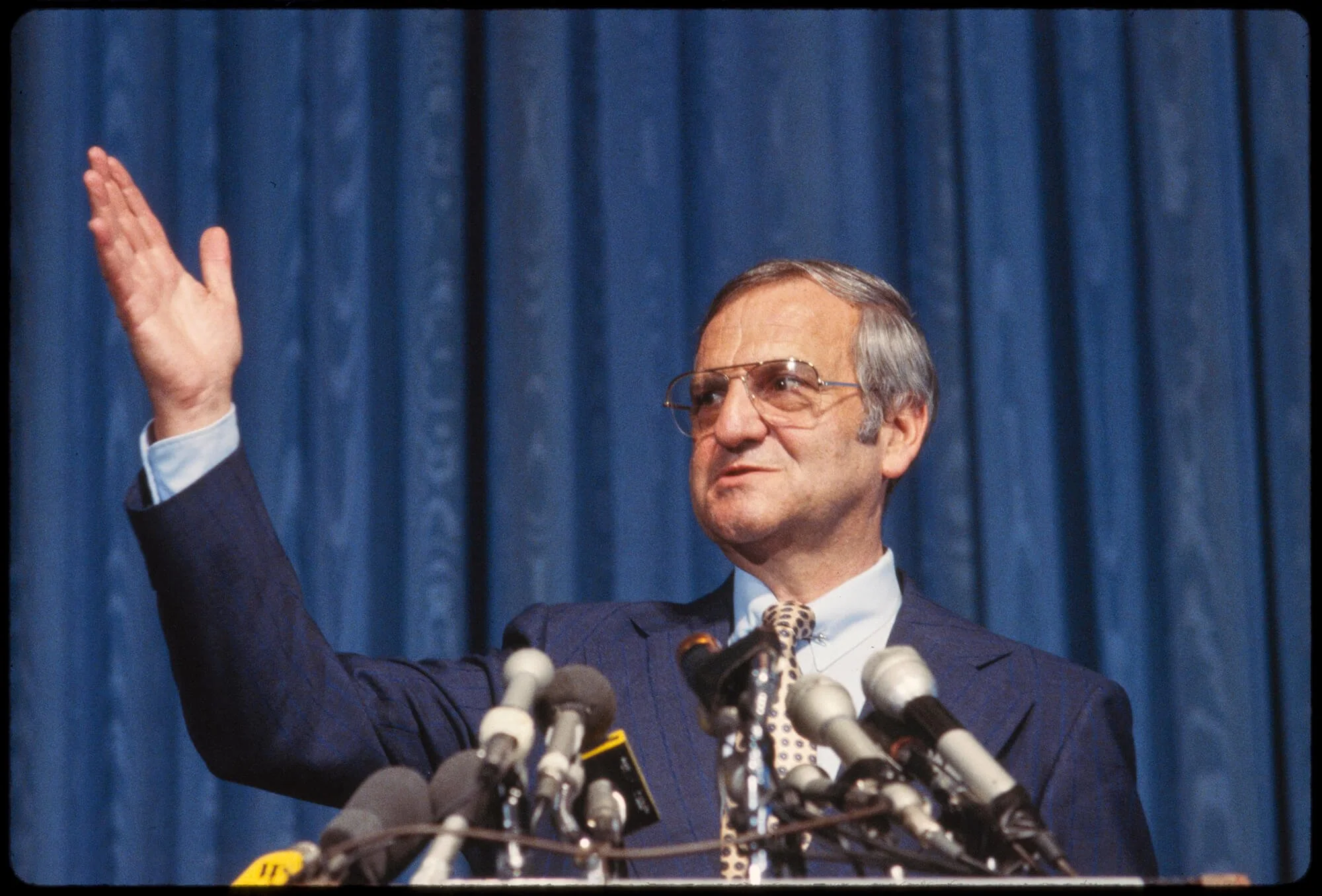
"Well, sometimes you just don't like somebody.”
These were the famous words Henry Ford II spoke to Lee Iacocca as he fired him from Ford Motor Company despite having brought the most profitable years in company history.
Lee’s relationship with Henry Ford II was difficult. Henry was an aristocrat while Lee was the son of Italian immigrants. Henry was the corporate shadow and Lee was a loud, cigar-smoking, media celebrity. When Henry finally gave the Board a “him or me” ultimatum, the Board pushed Lee out.
But the setback didn’t define Lee. A few months later Lee accepted an offer to become the President (and soon after, CEO) of Chrysler Corporation. There, he would face a challenge far tougher than internal politics at Ford.
Staring down bankruptcy (and winning).
Fast forward three years. Lee is delivering a speech at Chrysler’s annual shareholder meeting in 1981. With zero help from the U.S. economy, double-digit inflation, and spastic interest rates, Lee had shifted Chrysler from a company on verge of total liquidation to…
“A fighting organization that was on the leading edge of everything that is good with America.”
Lee was making it clear to shareholders that Chrysler was no longer a dying giant but a reinvented organization that could become a beacon to others…
“Those who once warned of the dangers of catching the Chrysler disease are now urging the rest of the country to take the Chrysler cure. Chrysler was once on the leading edge of everything that was going wrong with America, we are now on the leading edge of everything that is good with America.”
This moment was very important for Lee. He had kept Chrysler from spinning into the proverbial ditch and now he was ready to put the pedal to the metal. So in this moment, what idea was Lee selling to Chrysler shareholders?
A tiny idea with massive implications.
To the shareholders: Lee wanted them to understand that walking away would waste the sacrifice they had made...
“All the elements for our success are now in place. We have the plan. We have the products. We have the plants. And we have the people. I am convinced we can’t miss.”
To the employees paying attention: Lee wanted them to understand the battle was not them versus management. It was Chrysler versus the competition and the economy.
“We have a strong sense of unity and cooperation. We know how to sacrifice. And we are not afraid to ask for help and to provide it in return.”
And to everyone: Lee wanted them to understand that when the economy turned favorable, Chrysler would become the most renowned. car company in the U.S.
“We're going to become the pre-eminent automobile company of the 1980's.”
Throughout every bit of his speech, Lee is selling the idea that shareholders and employees should hold fast. Hold fast, because Chrysler was poised to become the greatest comeback story ever told, and Lee would make it happen.
How to ask your audience to fight when they want to flee.
I broke Lee’s speech down line by line to understand what device he used to persuade his audience. What I found was an ancient rhetorical device, formalized by Aristotle nearly 2,400 years ago. It’s known as the Aristotelian Triad or the Rhetorical Triangle.
Imagine a stool with three legs. If one leg is missing, the stool falls over. The same is true for the Rhetorical Triangle: all three legs are essential to make a persuading argument. Each leg answers a key question:
Ethos: Why should I trust you?
Pathos: Why should I care about this?
Logos: Does this make sense?
Effective persuasion uses all three elements, often in a specific cycle…
Ethos (the speaker’s authority) gets the audience to open up and listen.
Pathos (the speakers passion and emotion) helps the audience care.
Logos (the logic and proof) gives the audience the rationale for the argument.
When I dissected Lee’s speech, I found a beautiful pattern of all three elements of the Rhetorical Triangle woven throughout.
Lee’s intro has a near perfect mix of logic, authority, and passion (logos, ethos, and pathos) with slightly more weight on the passion and emotion. Remember, this was personal for Lee…
“The true story of the personal effort, the sacrifice, and the dedication that have brought this great company to this point in history will probably never be told.”
His main argument calls out seven key points primarily using logos (logic and proof) but each point is introduced by a small crumb of authority (ethos). Below is just one example of many. Look how he sets the facts as the leader and then supports them with logic…
“First, we have completed the most ambitious corporate restructuring program in history. We have negotiated new wage contracts with our unions, new debt arrangements with our lenders, cost reductions from our suppliers, and substantial reductions in our operating and fixed costs.”
And finally, Lee’s conclusion returns back to passion (pathos) while balancing back and forth like a teeter-totter with authority (ethos)…
“Chrysler is in a strong position to capitalize on any improvement in the market. We have the right products. We have the right value. And we have the right people. Chrysler is a fighting organization that didn't quit when the going got tough. And we won't quit now.”
Don’t pressure people to change. Persuade.
Lee couldn’t talk shareholders into holding fast any more than he could demand the union take a pay cut or force the bank to forgive debt. But he could persuade them, and that’s what he did.
What’s important to learn from Lee is that persuasion is a system. It takes all three elements (ethos, pathos, logos) to move people toward your vision as a leader.
If you’re struggling to persuade your people, look at your talking points. Are you offering a one- or two-legged stool? Or are you providing a stable foundation for persuasion?
Want to read Lee’s full speech? You can find it here.
Note: Quotes have been edited to improve readability while preserving meaning and voice.